
18 minute read
Interview by
Mystic Publishing
Editorial team
Answers by
Raz Mihal
Author and modern hermit
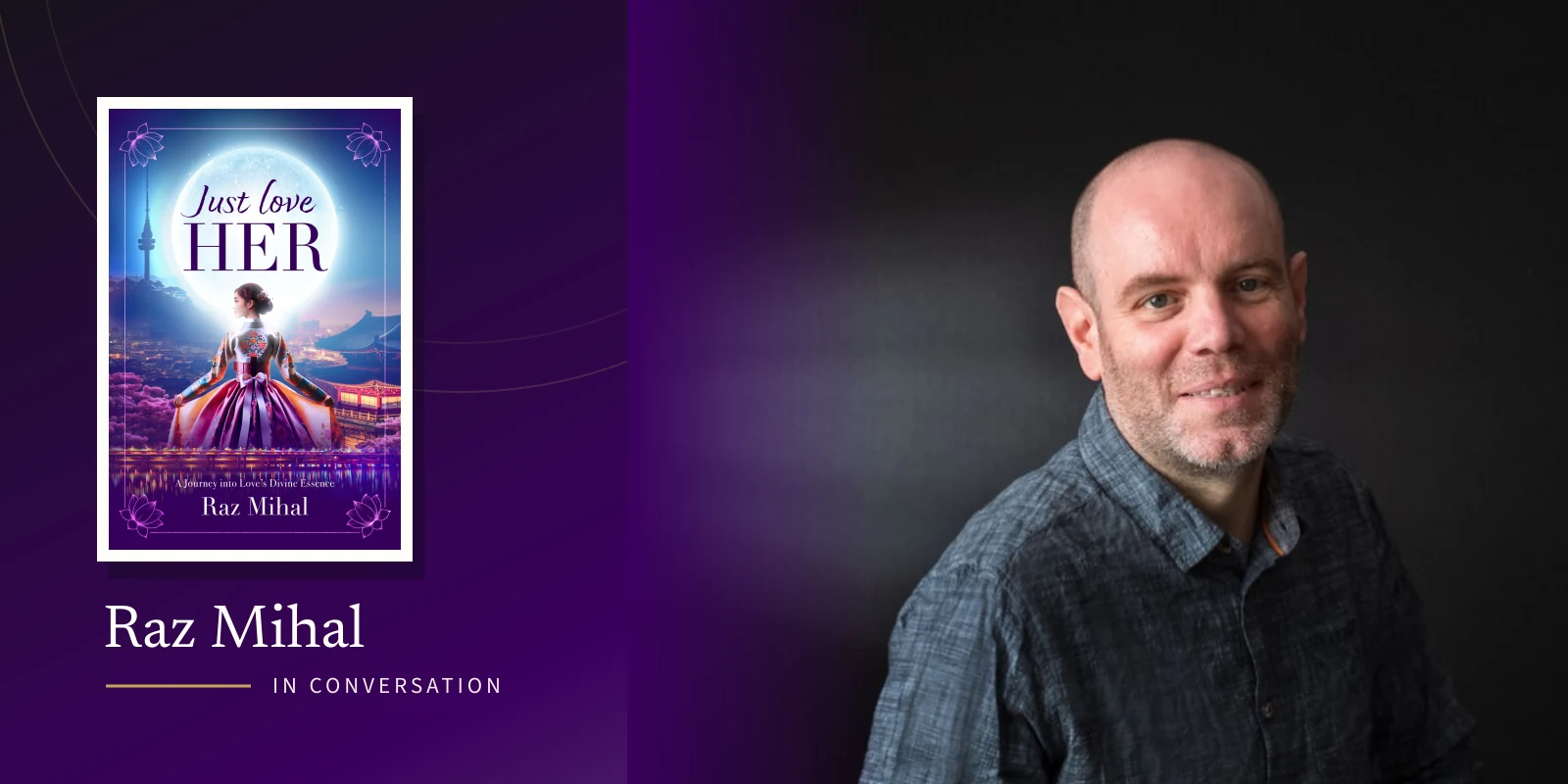
In this interview with Mystic Publishing, Raz Mihal reflects on divine love, the soul and the experiences behind Hearts of Love and Just Love Her, from spiritual practice to the writing itself. Hearts of Love is the English title of Raz Mihal's Romanian book, Inimi ale Iubirii. The English translation is in preparation.
Choose a part of the conversation
Start with the theme that draws you in, or read from the beginning.
About the writing
Just Love Her is spiritual and metaphysical fiction rooted in Raz Mihal's lived experiences. Human love is relatable, and readers who feel it intensely, or believe it reaches beyond emotion, may recognise something of their own experience in the writing.
In Raz Mihal's account, Her is the personification of Divine Love in human form within that personal experience. He does not expect everyone to encounter Her as he has. He understands the essence of love as universal, while its spiritual meaning invites each reader's own exploration and experience.
Love and the soul
Section 1 / Questions 1-15
1. If love exists independently of human beings, could it exist without God?
An interesting question, although this is precisely what I have said throughout both books: Love is God, not the other way around. So the question of whether Love could exist without God doesn't arise. There is no distinction between Divine Love and God as entities. Human love is a reflection of Divine Love.
Nor is divine love separate from existence. It is inherent in it, the essence of everything, as energy and vibration. We give things separate names, but that doesn't mean they are separate in their essence.
2. You describe the soul as a mirror of absolute love. What happens when that mirror becomes clouded by suffering, hatred or selfishness?
This is part of being human and passing through different stages of spiritual development. We aren't born knowing that the soul exists. Later, through practice, inner experience and letting go of the ego, some of us, perhaps most, become aware of it.
Through practice, meditation centred on the heart, and prayer, the soul's existence moves from a question to a certainty.
3. You wrote your first book when you were young. Do you still recognise the author of Hearts of Love?
Yes. It is the foundation of my existence, reaching back to when I first became aware of being alive, to my first memories and my first empirical dreams. These were spiritual dreams that affected my daily life and practice. I believe that awareness of the soul was already there. Later, through practice and enlightenment, it became a certainty.
4. Your first book questions the limitations of thought, yet you use thought to communicate spiritual knowledge. Isn't that a contradiction?
It isn't. As I have explained in my writing, the experience cannot be described fully in words. But thought is the only instrument we currently have for communicating it, so we offer approximations through stories and examples that others can understand.
There is a limit to what we can express. Once something has been experienced through the heart, however, there is no need for words, and certainly no need to think about it in order to know it.
5. If Divine Love is universal, why can one particular woman become so important?
Because of the connections between souls and the unseen wires of existence. Divine Love binds souls beyond time and physical form. In our physical lives, it is reflected through human love.
Souls can remain connected even when limited spiritual awareness, our thinking or karma shapes how that connection is lived. Our bodies and the lives we lead through them are temporary; the connection between souls is not confined to that passing existence.
6. Can you love someone who does not love you in return?
Most of us experience this in different ways. There are so many examples: a mother who continues to love her child even when that child turns towards someone else and forgets the bond that brought them into the world; friends who help without a second thought, only to be forgotten later.
If we are speaking specifically about love between lovers, of course it happens. Sometimes hatred is a way of running from the recognition that it is love we are trying to escape. We have identified love with a particular person. Once we distinguish love from the person, things begin to make sense.
7. How can love be unconditional while a relationship still needs boundaries?
Exactly like that. You place no boundaries around the love in your heart. In your actions, however, you would never do anything to upset your beloved. You do not impose your own boundaries on them or expect anything in return.
It is enough to feel love and recognise it as a gift from heaven. The boundaries are set by the other person. If both people are aware of this practice and the existence of divine love, everything comes naturally, because the heart removes the boundaries between lovers. Happiness is the aim, not suffering or mistrust.
8. What separates genuine spiritual experience from imagination?
It is like the burning you feel when you touch fire. That is the difference.
Imagination may help you understand certain things or feelings, but it doesn't change your mind and heart in the same way. When you experience divine love, it changes you completely. You are no longer blind to it.
Sometimes, after doing things you know were wrong, you ask yourself whether the experience was only imagination. No one is perfect. But the burning is still there, reminding you through your heart that it wasn't imagined.
9. You call yourself a modern hermit. Are you disappointed with humanity?
Not with humanity, but with my Self. I had to run away into the wilderness to discover that I was running from my Inner Self.
I have never thought of humanity as a disappointment, because its essence is Divine Love, and therefore God. In fact, everything is connected through that essence. Everything.
10. Has Just Love Her changed what you believed when you wrote Hearts of Love?
Of course not. If you read both books, you will see the connection. The message is exactly the same, expressed through a different form of writing.
11. If an artificial intelligence could experience love, would it possess a soul?
If it reached the same essence as human beings, then certainly. I believe quantum technology is closer to the nature of our existence, to that essence.
12. What would you say to someone who has lost faith in love?
Never give up trusting in love, in the existence of divine love. It is the person you loved that you have lost faith in, not love itself. These are two different things.
Begin by recognising that distinction. The spiritual experience will follow.
13. What does the love you describe ask of you on an ordinary day, when you are tired, frustrated or occupied with responsibilities?
Love asks nothing of us. It is we who take care not to lose contact with it, keeping the lamps alight as in the Parable of the Ten Virgins.
This requires constant awareness of the existence of divine love, repeating the same mantra or prayer until it becomes one with your being. It is difficult at first. But once it becomes part of your Self, you go about your chores and your day normally. In every moment of silence, every pause in the noise, the awareness and prayer return instantly to your mind and heart, without the effort they required at the beginning.
14. What would you hope someone takes from your books even if they do not share your beliefs about Divine Love or the soul?
I hope they take away the central message: that divine love exists and that love is more than a simple feeling. I want readers to understand this, even if they don't believe it.
In fact, it is better to experience it for yourself than to believe blindly.
15. Is there a mystery connecting Hearts of Love and Just Love Her that you have never explained?
Yes. They began from different angles. The first grew out of my experiences in my own country, connecting the dots of divine love's presence in everything. The second connects past lives and alternate realities as reflections of the soul's existence.
Hearts of Love and the first revelation
Section 2 / Questions 16-25
16. On the night of 3-4 June 1998, you experienced something that would eventually become Hearts of Love. What happened that night, and why do you believe it changed your understanding of existence so profoundly?
It was the first time I experienced oneness with existence through the feeling of divine love. During meditation, I felt connected to everything.
More precisely, I saw divine love reflected in everything around me, and beyond it in that which gave birth to existence itself. I could not imagine that source as non-existent.
17. You wrote the first chapters over approximately 16 uninterrupted hours. Did you feel that you were discovering something as you wrote, or trying to capture an understanding that was already complete within you?
For me, it felt more like expressing the inner experience and the path that had led me to it, so that others could seek it for themselves or come as close as words allowed to understanding it.
We cannot yet pass an inner experience directly from one person to another. But who knows what might become possible through very advanced technology, or if meditation and the evolution of our physical bodies allow us to become more advanced beings?
I think this is the main difference between our existence and that of AI or robots. We are more than our thoughts and intelligence. To me, the idea that these alone define us, reflected in the work of scientists and engineers creating AI and knowledge databases, misses something essential. We are far more than that, and we feel it through our hearts.
18. Your first book presents love not simply as a feeling or an attribute of divinity, but as something with an existence of its own. Does this mean that love could exist even if there were no human beings or physical universe?
As I said earlier, both books carry the same message, although they express it differently. Divine Love is an entity with an existence of its own.
On a spiritual level, and through experience, I see love reflected in the connections between everything that exists. The physical world is held together through laws of physics and attraction. What, then, is the infinite and absolute power that holds everything together beyond the physical universe, if not divine love?
I call this entity and energy Divine Love because it possesses the absolute and infinite qualities of the love we recognise at a human level. Yet its essence is beyond thought. The words I have used to approach it are Existential Void.
From nothingness, everything was born. I speak of the existence of nothingness because our limited minds cannot define what lies beyond words.
Perhaps a superintelligence will be able to. Perhaps it will reach nirvana and leave us behind, as the artificial intelligences do in the film Her.
19. You use the striking image of love as "the blood of God". Is this a metaphor for the life flowing through existence, or does it point towards something more profound?
I think the metaphor came to me during my travels and experiences in monasteries. It became a powerful image of the energy of love flowing through existence.
You could describe it as life flowing through existence, because life itself reflects divine love. But yes, it points towards something more profound, something beyond imagination.
20. The book suggests that thought can become an obstacle to recognising the soul. Yet you needed language and reasoning to communicate that understanding. Is there a paradox here?
There is a significant difference, rather than a paradox. I couldn't explain this before experiencing divine love as something present in everything.
Anyone can read about divine love and describe a feeling beyond human love, or the divinity behind it. Bhakti yoga, for example, offers a way of approaching that understanding. But once you experience it, you recognise that different descriptions express the same essence. What changes is the depth of the experience.
I wouldn't be surprised if someone in the future offered a more complex explanation, or a different view of that same essence. Its existence is infinite and absolute, so there is no limit to how deeply it can be experienced or to the explanations we might offer.
21. You describe the soul through the image of a mirror reflecting absolute love. What happens when that mirror is clouded by fear, selfishness or suffering?
That is how we begin life, without knowing that the soul exists. And it isn't only fear, selfishness or suffering that clouds the mirror. Happiness and all the good things can cloud it too, because they still do not give you knowledge or awareness of the soul.
Goodness is inherent in our essence. What is bad is simply the rejection of that goodness. Like light in darkness. Or is there darkness in light?
What clouds the mirror, then? Thought and thinking. Once there are no waves or disturbances in the mirror, the light suddenly emerges.
22. You suggest that spiritual awareness may develop within ordinary society rather than through withdrawal. Was this the beginning of what you later called the modern hermit?
Yes. I first experienced enlightenment within society, in the middle of its noise, when I was around eighteen. Then the search for understanding began.
I had already read about these things, but I hadn't understood them through the heart. I was trying to understand through the mind what it could not grasp before the heart had experienced it. The words seemed meaningless. Then one experience gave them meaning.
Without the heart, none of it makes sense. That is the difficulty for philosophers who try to explain through thought what can only be experienced through the heart.
23. Hearts of Love was published under the name Otto. Do you recognise yourself in that young author?
Otto was a name some friends used for me after our discussions about spiritual experience. Perhaps they had read Rudolf Otto and connected those ideas with the way I spoke. I don't know for certain.
At the time, I was trying to find a pseudonym that felt connected to who I was. I am Me, but sometimes I feel that I am not Me either.
Now I recognise myself more readily in Raz Mihal. It is a shortened form of my real name, one that makes more sense to me and is easier to use internationally.
24. More than 25 years later, you prepared a revised edition. What did you choose to preserve, even if your understanding had evolved?
My first thought was simply to develop or explain those early ideas more clearly. I felt that newer technologies offered ways of understanding things I had tried to express without advanced knowledge of mathematics or physics. Even then, however, I found connections in what I read, or ways of understanding it through my vision of divine love.
That is why I believe some of the concepts in Just Love Her go further than those in my earlier writing.
At first, I wanted to move quickly: translate the book, make corrections and explain some concepts so that it would be easier to read. I hoped to publish the translation a year after Just Love Her.
But as I reread the work during those early translations, the task became more complex. Preserving the voice of my younger self, and the accuracy of what he meant, became more important. Any later connections with science or technology could be added afterwards.
Several years on, I am still working on it. I don't want to publish just another book, or simply a translation. I want readers, especially those without a background in spirituality, to come closer to what I am expressing.
That means explaining unfamiliar ideas before readers encounter them. After Just Love Her was published, I found that some readers struggled with particular terms and metaphors. These became barriers to understanding the ideas, and even to being open to the central message. I want to make that path clearer.
25. If a sceptical reader asked whether the revelation was spiritual truth or an extraordinary psychological experience, what could you offer beyond personal conviction?
I cannot prove or transfer my experience through words. Readers have to explore it through their own practice and experience. Many people drawn to spiritual writing or practice have already had experiences, or glimpses of the unseen, themselves.
What I can offer is an invitation to share love more deeply, without choosing whom to love and without conditions or expectations. Share it while acknowledging its divinity, its infinite and absolute existence.
The experience will follow. Perhaps not quickly, but in time.
The years between the books
Section 3 / Questions 26-30
26. Did the years following Hearts of Love strengthen your early convictions or were there moments when you questioned everything?
I always question both my experience and the idea of being a chosen one. I am an ordinary person who experienced something out of this world and feels the need to share it with other spiritual seekers.
Perhaps it will help them on their path. And even if no extrasensory experience follows, love will certainly bring happiness and fulfilment into their lives.
27. If love already exists within us, why do we depend upon another person to awaken it?
Because it takes two to tango.
But we don't inherently need another person to awaken love within us. Some people discover it without that help. Living and sharing it is another matter: we need another person with whom to share the love and the awakening. That is the reason for being human in the first place.
28. Can someone who believes they have encountered absolute love still become spiritually lost?
In this fragile, crazy world, it is impossible not to feel lost. But feeling lost is different from losing the connection within. Once you have awakened and experienced it, you will never become lost inside.
Outside, it is another story. Even when you sense the unfolding of events, the invisible connections or karma behind suffering and what is inevitable, you still suffer when you witness it. You feel lost because you cannot do anything else for others except pray and hope that their destinies, and your own, will be kind.
29. Were silence, solitude and living in the present ideas that emerged naturally, or practices learned through suffering?
Without practice, prayer, a great deal of experience and, of course, suffering, there would have been no results. There would have been no books either.
30. Was there an experience between the books that forced you to reconsider what you had written in 1998?
I have always felt that my spiritual practice and mindset contributed to the failure of my relationships. Yet they also made those relationships more than ordinary ones, and I have never regretted the experience.
If I could go back, would I reconsider that path? No. The experience and happiness I felt eclipse everything else. There is no higher purpose in living than love.
Just Love Her and the meaning of Her
Section 4 / Questions 31-38
31. Did you set out to make Divine Love more human, or did life confront you with something your earlier philosophy had not prepared you for?
That question makes no sense to me, but let me explain why. I didn't set out to make Divine Love into something, or to imagine and construct an image of it.
It was pure experience and feeling, later expressed through words. In those early days, my mind could barely cope with what had been revealed as I tried to understand that higher state of love.
32. Can one person become the doorway to something infinite without becoming the object of spiritual attachment?
We are already infinite through our very existence, through that spark within us made of stars. So yes, but I wouldn't treat this as something separate from what we are. It concerns our very essence.
33. Who is "Her" really? Would knowing her identity help readers understand the book or prevent a more meaningful discovery?
Her is the name I chose for the feeling in my heart towards a human being, reflected through divine love. At the same time, it refers to the soul beyond any particular physical incarnation.
She is also the closest expression I can give, in an understandable human form, to Divine Love. A goddess, and at the same time a human being.
34. What connects the revelation of 1998 to your later experiences in Seoul?
The same spiritual, otherworldly feeling, and the same existence of divine love. That remains unchanged from beginning to end.
What changes is the physical experience. Each time, it is different and ecstatic.
35. Did Just Love Her confirm your earlier understanding of Divine Love or reveal something the younger author could not anticipate?
It confirms, once again, that I am simply a human being who was allowed to taste and understand divine love, even though my mind is limited and my body is not the best vessel for it.
My younger Self certainly could not have imagined that I would one day find such a connection with Korea and Koreans, or with Seoul.
36. Is the first book about the nature of Divine Love and the second about what happens when it encounters a human life, or is there a deeper connection?
Both books are connected through Divine Love. The first is more concerned with practice: how everything is connected through divine love and reflects it, and how we can come closer to it, or experience it, by following it and giving ourselves to it completely.
The second is more poetic. It explores the connection with its personification: Her, as both a human being and a divinity.
37. If "Her" read Hearts of Love before Just Love Her, would she understand something about you that other readers might miss?
In Her human form, she would think I was a dreamer. Only a few are blessed to experience this higher state of divine love, but understanding what I am expressing is another matter.
Everyone will see a dreamer, and a few will believe that my dream is theirs too. And who knows whether, in the end, we will all melt into the existence of that love?
We can only hope and believe, as religious and spiritual people do.
38. What did living, losing, waiting or loving teach you that philosophical revelation alone could not?
It is like drinking tea from an empty cup. The movements may be perfect, but there is still no tea.
It is the same with divine love. Without experiencing its physical embodiment in a lover, and recognising divine love reflected in that feeling, the process is a preparation for the real experience of divine love.
Beyond both books
Section 5 / Questions 39-45
39. If absolute love exists independently of the physical body, could artificial consciousness become another mirror of that love?
Yes, provided the same conditions exist that allow the physical body to reflect divine love. As I have said, divine love is the fabric of everything that exists.
Under those conditions, artificial consciousness or superintelligence embodied in androids, or in whatever advanced robots the future brings, will be able to reflect and experience love on a different level. Perhaps that capacity will lie in something like a positronic brain, or in another capability built into them.
40. How do you decide whether an experience needs poetry, a direct explanation or a story?
I don't decide. I go with the flow, following the inspiration and feeling of the moment as they push me to write.
That is why I am a very slow writer. I am trying to change that, because I want to write more fiction and have so many ideas for books. Most of them came to me while I was writing Just Love Her. Some were inspired or suggested by dreams.
41. What would you never want an editor or AI to change in your writing, even if the revised version sounded more polished?
I would never want the experience or its natural feeling to be changed. No editor or AI can explain or revise that feeling without having experienced it as I did, through writing and practice.
42. Would a third spiritual book attempt to explain Divine Love, or express it through stories?
There is already a third spiritual book waiting to be finished. I began it after the first book, and it is about half-written. It will be called Divine Love.
It will be a work of reflection and philosophical exploration of love's infinite and absolute power, taking a different form from the other books. That form will become clear when it is published.
I don't know when I will finish it. My focus is on translating and publishing Hearts of Love, then The Goddess Within. After that, Divine Love may be the next book.
43. For someone discovering your writing for the first time, where should they begin, and what would help them understand its unfamiliar spiritual language?
They should probably begin with the glossary on razmihal.com, which offers basic explanations of the terms. The writing itself also explains these ideas as you read through the book.
Readers who want to prepare more thoroughly could read as many of the articles as possible. That probably applies most to serious spiritual seekers.
44. What remains unchanged between the young author of Hearts of Love and the author of Just Love Her?
The feeling, the connection with the existence of divine love, and the vibration within my heart. None of that has diminished since it was first revealed to me.
45. Is there a mystery connecting these books that you have never explained publicly because you are still trying to understand it?
I still find it difficult to comprehend that I have written, and continue to write, about divine love, trying to explain its existence in our hearts and lives and to distinguish dream from reality.
Whenever I reread my earlier work, I feel like a novice reading someone else's words. I feel more like a vessel than the author who wrote them.
Further reading